Precision in Every Signal

Breakthrough stochastic damping for bidirectional signal regularization and generative fractal modeling.


Proven Performance

Powered by our proprietary operator, TRNS (Temperature-Regularized Navier-Stokes)

RMS reductionSNR gains
1.3X to +5.1X+10dB to +31dB

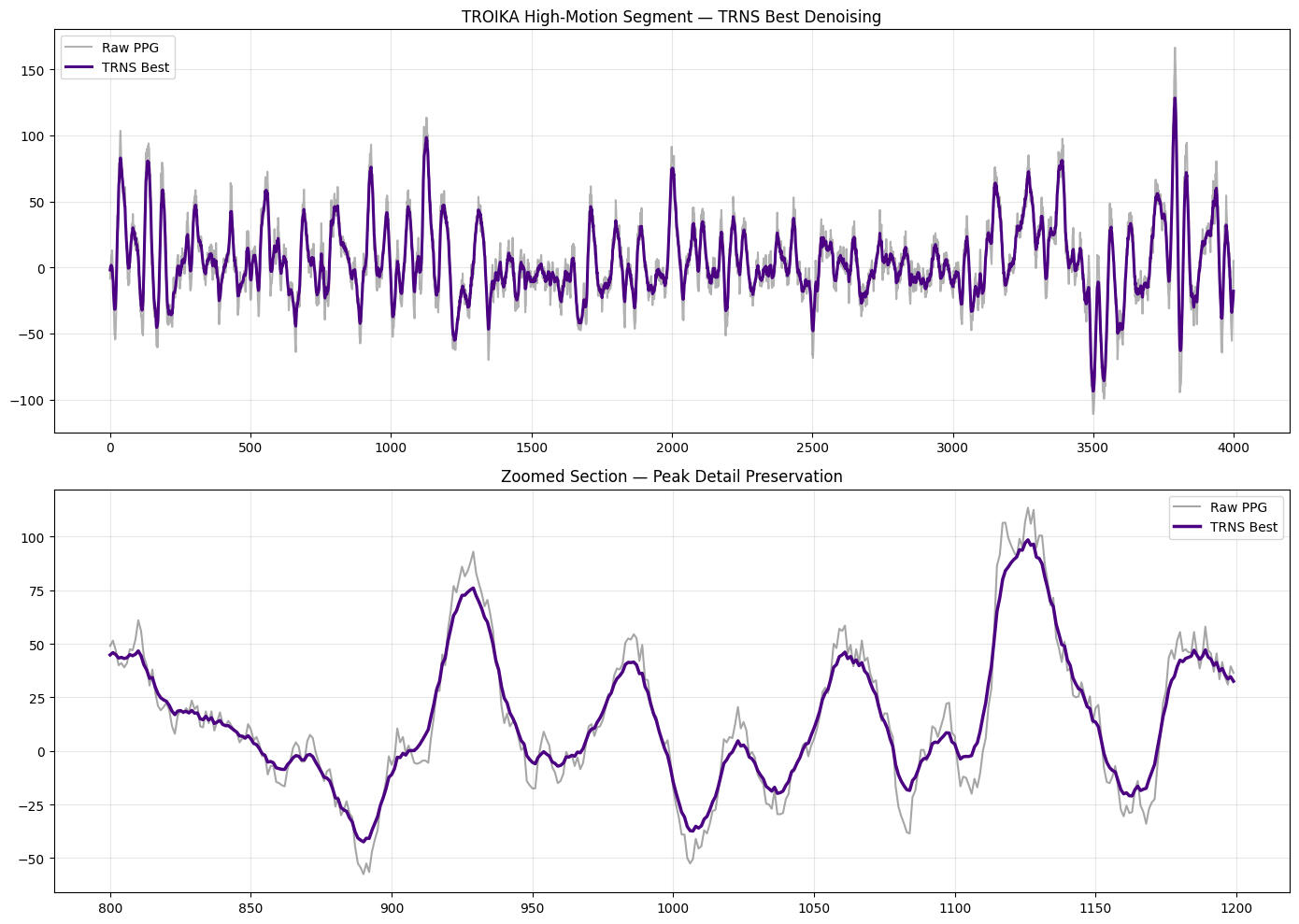
Results vary by signal type and noise level. Real world examples include 5.09x RMS reduction on motion-contaminated wrist PPG (TROIKA dataset) and up to 10x+ in certain high-noise cases.

  • Reduces noise across diverse signals while preserving underlying structure

  • Suppresses motion artifacts, sensor noise, and baseline wander

  • Bidirectional operation: backward denoising + forward generative mode

  • Lightweight and real-time capable on standard embedded processors

  • No training data or black-box models required

  • Serves as an efficient pre-denoising layer for deep learning models, reducing AI compute and power requirements


Key Applications

Backward Mode – Denoising Applications
(Real-time noise suppression and artifact removal)

  • Medical sensors (PPG, ECG, ultrasound RF, infusion) – motion artifact and sensor noise reduction

  • Fluid dynamics & propulsion (engines, turbines, rockets) - real-time denoising of pressure, temperature, vibration, and flow sensors in high-performance systems

  • Data center liquid cooling systems – denoising flow, pressure, and temperature sensors in cooling loops

  • Oil & gas pipeline flow assurance & reservoir simulation – denoising multiphase flow and pressure sensors

  • Radio-frequency & long-range comms (cellular 5G/6G, radar, satellite, Wi-Fi, Bluetooth) – denoising weak or interfered signals

  • Consumer wearables – ANC headphones & earbuds – real-time acoustic noise cancellation under motion

  • Marine hydrodynamics & underwater acoustics – denoising acoustic and vibration signals

  • Microseismic & geothermal monitoring – noise reduction in seismic and downhole sensor data

  • Wind energy (turbine blade & wake flow) – denoising sensor data from turbines

  • LiDAR & 3D sensing – cleaning noisy point-cloud returns

  • HVAC & industrial ventilation – denoising airflow and thermal sensors

  • Edge-AI pre-denoising – lightweight pre-processing layer to reduce compute load

Forward Generative Mode – Prediction & Synthetic Modeling Applications
(Path-of-least-resistance fractal prediction and synthetic data generation)

  • Data center liquid cooling systems – predictive modeling of coolant flow and thermal distribution

  • Oil & gas pipeline flow assurance & reservoir simulation – synthetic multiphase flow and pressure prediction

  • Fluid dynamics & propulsion (engines, turbines, rockets) – generative modeling of turbulent flow, combustion, and pressure oscillations

  • Chemical processing & pharmaceuticals – generative simulation of reactor mixing and crystallization paths

  • Marine hydrodynamics & underwater acoustics – predictive modeling of hull/propeller flow and acoustic propagation

  • Wind energy (turbine blade & wake flow) – generative prediction of turbulent wakes and blade loading

  • HVAC & industrial ventilation – predictive airflow and thermal modeling

  • Synthetic data generation for AI/ML training – creating realistic time-series and flow data

  • Weather & climate modeling – generative prediction of turbulent atmospheric flows and storm paths

  • Material science & additive manufacturing – fractal modeling of crystal growth and solidification

  • Biological & tissue growth modeling – path-of-least-resistance simulation of vascular networks and wound healing

  • Traffic & urban flow prediction – generative modeling of vehicle, pedestrian, and crowd dynamics

  • Energy grid optimization & power flow modeling – predictive path-of-least-resistance for grid stability

  • Procedural content & simulation (gaming, CGI, digital twins) – real-time fractal generation of fluids and terrain

  • Drug discovery & molecular dynamics – generative modeling of molecular folding and diffusion paths

Our Licensing Model
Non-exclusive licenses are available across all categories.
Each licensee receives:
• Quick-Start Tuning Guide + example code
• Synthetic benchmark datasets
• Limited integration and tuning support

Meadows McKnight LLC • Patent Pending • U.S. Patent Application No. 19/671,179 © 2026 All Rights Reserved

Contact Us

For licensing discussions, technical or general questions, or partnership opportunities, please fill out the form below. We typically respond within 1-2 business days.

Technology and Applications

Additional categories and application examples are in development and will be added regularly

Meadows McKnight LLC • Patent Pending • U.S. Patent Application No. 19/671,179 © 2026 All Rights Reserved

About Us

Meadows McKnight LLC was founded by husband-and-wife team Jennifer and Clinton Meadows to develop and license breakthrough, physics-inspired signal processing technology.
Jennifer Meadows is the inventor of TRNS (Temperature-Regularized Navier-Stokes), a lightweight stochastic damping framework that dramatically reduces noise in real-world signals while preserving critical underlying patterns. With a background in medical laboratory technology and business administration, she spent years working in clinical environments before dedicating herself full-time to independent research. Her work focuses on practical, training-free solutions for medical devices, industrial sensors, edge-AI systems, and other noisy data environments.
Clinton Meadows serves as CEO and Co-Founder. With over 15 years of experience in industrial operations, equipment reliability, continuous improvement, and regulatory compliance, he brings deep practical expertise to the business. He holds a B.S. in Industrial Technology and an M.B.A.
Together, they are building Meadows McKnight as a lean, focused intellectual property company dedicated to non-exclusive licensing of high-impact denoising and generative modeling technology. Their mission is to deliver meaningful performance improvements to partners in medical devices, aerospace, data centers, seismic monitoring, LiDAR, and edge-AI — all while maintaining a family-first culture in East Texas.

Meadows McKnight LLC • Patent Pending • U.S. Patent Application No. 19/671,179 © 2026 All Rights Reserved

Page 1 of 3

Data Cooling Systems

HVAC Energy Data (Chiller-focused)

Dataset Provenance
The dataset used in this demonstration is HVAC Energy Data (Chiller-focused), publicly available on Kaggle. It contains real operational measurements collected from a commercial chiller system in a building located in Singapore.
Description
This dataset includes key operational variables such as chilled water flow rate, cooling load, energy consumption, and weather data (temperature, humidity, etc.). The data spans from August 2019 to June 2020 and reflects realistic chiller operation under varying building loads and environmental conditions.
It serves as an excellent real-world testbed for evaluating denoising performance in data center liquid cooling and HVAC applications, as it captures actual operational dynamics, load variations, and environmental influences on chiller performance.

Denoised with TRNS

Performance Comparison

Performance ranges shown are typical values reported in literature and industry benchmarks for each method. Actual results vary by application and implementation.

Why TRNS Numbers Are Superior in Practice
Higher RMS numbers from heavy ML models often come at the cost of oversmoothing, which removes legitimate operational transients (load changes, flow variations, and thermal responses) that control systems and optimization algorithms depend on.
TRNS delivers a balanced 2.09× reduction that removes unwanted noise while respecting the underlying physics of the chiller system. The denoised signal demonstrates strong noise suppression while faithfully preserving meaningful operational variations.

In our demonstrations, we tune TRNS to achieve the best overall balance between noise reduction and preservation of real-world signal dynamics, rather than pursuing the absolute highest RMS number possible.
While TRNS parameters can be adjusted to reach higher RMS reductions (sometimes comparable to advanced machine learning methods), we intentionally prioritize practical performance. Excessive denoising frequently leads to oversmoothing, which can remove important physical transients, degradation trends, or operational signatures critical for real applications such as fault detection, predictive maintenance, and process control.
TRNS is designed to deliver strong, usable results that respect the underlying physics of the system.

Citation
Chiller_Energy. (Year). Chiller Energy Data [Dataset]. Kaggle. Retrieved from https://www.kaggle.com/datasets/chillerenergy/chiller-energy-data (or search for “Chiller Energy Data” / “HVAC Energy Data” on Kaggle).

Meadows McKnight LLC • Patent Pending • U.S. Patent Application No. 19/671,179 © 2026 All Rights Reserved


Page 2 of 3

Data Cooling Systems

Cooling Tower Optimization

Dataset Provenance
The dataset used in this demonstration is the Cooling Tower Optimization Dataset, publicly available on Kaggle. It contains real operational measurements from a cooling tower system over multiple years.
Description
This dataset includes real-time operational data collected from industrial cooling towers between 2018 and 2024. Key variables include outdoor temperature, humidity, wind speed, water inlet and outlet temperatures, energy consumption, cooling capacity, air velocity, and system load metrics.
It provides an excellent real-world testbed for evaluating denoising performance in data center liquid cooling towers and HVAC systems. The data captures realistic operational dynamics, varying environmental conditions, and system loads — conditions that closely mirror those found in modern, energy-intensive data center cooling infrastructure.
Cooling tower signals (such as inlet/outlet temperatures and energy consumption) were selected for this embodiment because they contain meaningful operational trends mixed with high-frequency sensor noise, making them ideal for demonstrating the TRNS stochastic damping operator’s ability to clean noisy time-series data while preserving critical performance patterns.

Denoised with TRNS

Performance Comparison

Performance ranges shown are typical values reported in literature and industry benchmarks for each method. Actual results vary by application and implementation.

Why TRNS Numbers Are Superior in Practice
While some advanced hybrid ML or deep learning approaches can report higher raw RMS numbers, they frequently oversmooth the signal — removing legitimate operational transients (e.g., load changes, fan cycling, thermal responses) along with noise. These dynamics are vital for control systems and optimization algorithms.
TRNS achieves a balanced 2.08× reduction that respects the underlying physics, making it far more practical for real-world deployment in data center cooling infrastructure.

In our demonstrations, we tune TRNS to achieve the best overall balance between noise reduction and preservation of real-world signal dynamics, rather than pursuing the absolute highest RMS number possible.
While TRNS parameters can be adjusted to reach higher RMS reductions (sometimes comparable to advanced machine learning methods), we intentionally prioritize practical performance. Excessive denoising frequently leads to oversmoothing, which can remove important physical transients, degradation trends, or operational signatures critical for real applications such as fault detection, predictive maintenance, and process control.
TRNS is designed to deliver strong, usable results that respect the underlying physics of the system.

Citation
Ziya. (2024). Cooling Tower Optimization Dataset [Dataset]. Kaggle. Retrieved from https://www.kaggle.com/datasets/ziya07/cooling-tower-optimization-dataset

Meadows McKnight LLC • Patent Pending • U.S. Patent Application No. 19/671,179 © 2026 All Rights Reserved


Page 3 of 3

Data Cooling Systems

Data Center Cold Source Control

Dataset Provenance
Brief Provenance The dataset used in this demonstration is the Data Center Cold Source Control Dataset, publicly available on Kaggle. It represents real-world operational data from a modern data center’s liquid cooling infrastructure.
Description
This dataset contains 3,498 hourly time-series records from a modern data center’s cold source group control system, which includes chillers and air handling units (AHUs). It focuses on energy-efficient operation while maintaining temperature stability.
Key variables include server workload (%), inlet and outlet temperatures (°C), ambient temperature (°C), cooling unit power consumption (kW), chiller and AHU usage levels (%), energy cost, and temperature deviation (°C).
This dataset was chosen because it closely mirrors the types of noisy, multivariate time-series signals encountered in commercial data center liquid cooling systems deployed by major operators and OEMs. It provides an excellent real-world testbed for evaluating denoising performance in high-value, energy-intensive data center cooling applications.
Signals such as cooling unit power consumption and inlet/outlet temperatures were selected for this embodiment because they contain meaningful operational trends mixed with high-frequency sensor noise, making them ideal for demonstrating the TRNS stochastic damping operator.

Denoised with TRNS

Performance Comparison

Performance ranges shown are typical values reported in literature and industry benchmarks for each method. Actual results vary by application and implementation.

Why TRNS Numbers Are Superior in Practice
While some advanced machine learning approaches can achieve higher raw RMS reduction numbers in controlled tests, they frequently oversmooth the signal — removing not only noise but also legitimate operational transients such as workload spikes, chiller cycling, and pump variations. These dynamics are essential for energy optimization, fault detection, and stable control systems.
TRNS delivers a balanced 2.02× noise reduction that removes unwanted noise while respecting the underlying physics of the cooling loop, resulting in more reliable and actionable data for real-world data center operations.

In our demonstrations, we tune TRNS to achieve the best overall balance between noise reduction and preservation of real-world signal dynamics, rather than pursuing the absolute highest RMS number possible.
While TRNS parameters can be adjusted to reach higher RMS reductions (sometimes comparable to advanced machine learning methods), we intentionally prioritize practical performance. Excessive denoising frequently leads to oversmoothing, which can remove important physical transients, degradation trends, or operational signatures critical for real applications such as fault detection, predictive maintenance, and process control.
TRNS is designed to deliver strong, usable results that respect the underlying physics of the system.

Citation
Python Developer. (2024). Data Center Cold Source Control Dataset [Dataset]. Kaggle. Retrieved from https://www.kaggle.com/datasets/programmer3/data-center-cold-source-control-dataset

Meadows McKnight LLC • Patent Pending • U.S. Patent Application No. 19/671,179 © 2026 All Rights Reserved

Page 1 of 6

Fluid Dynamics & Propulsion

Computational Fluid Dynamics (CFD) Laminar vs Turbulent Flow

Dataset Provenance
The dataset used in this demonstration is the Computational Fluid Dynamics - Laminar vs Turbulent Flow Dataset, publicly available on Kaggle. It contains simulated 2D channel flow data generated from the Navier-Stokes equations.
Description
This dataset consists of 10,000 samples (5,000 laminar and 5,000 turbulent) with 14 features per sample, including spatial coordinates (x, y), velocity components (u, v), pressure (p), velocity gradients, and a categorical flow_type label.
It was generated using simplified Navier-Stokes-based simulations:
• Laminar flow based on the analytical Poiseuille solution with added noise.
• Turbulent flow evolved with a basic Navier-Stokes solver and random perturbations.
This dataset provides a direct mathematical connection to the Navier-Stokes equations that underpin the TRNS stochastic damping operator. It serves as an excellent testbed for evaluating denoising performance on velocity and pressure fields in fluid dynamics applications.
Velocity components (particularly u and v) were selected for this embodiment because they contain meaningful flow structures mixed with numerical noise and regime transitions — conditions representative of real-world challenges in propulsion systems, compressors, ducts, and aerodynamic design.

Denoised with TRNS

Performance Comparison

Performance ranges shown are typical values reported in literature and industry benchmarks for each method. Actual results vary by application and implementation.

Why TRNS Numbers Are Superior in Practice
TTRNS achieves a strong 6.10× noise reduction while respecting the underlying physics of fluid flow. This makes it particularly valuable for post-processing CFD results in propulsion, aerospace, and turbomachinery applications, where preserving accurate velocity and pressure structures is critical for analysis and design validation.

In our demonstrations, we tune TRNS to achieve the best overall balance between noise reduction and preservation of real-world signal dynamics, rather than pursuing the absolute highest RMS number possible.
While TRNS parameters can be adjusted to reach higher RMS reductions (sometimes comparable to advanced machine learning methods), we intentionally prioritize practical performance. Excessive denoising frequently leads to oversmoothing, which can remove important physical transients, degradation trends, or operational signatures critical for real applications such as fault detection, predictive maintenance, and process control.
TRNS is designed to deliver strong, usable results that respect the underlying physics of the system.

Citation
Allanatrix. (2024). Computational Fluid Dynamics [Dataset]. Kaggle. Retrieved from https://www.kaggle.com/datasets/allanwandia/computational-fluid-dynamics

Meadows McKnight LLC • Patent Pending • U.S. Patent Application No. 19/671,179 © 2026 All Rights Reserved


Page 2 of 6

Fluid Dynamics & Propulsion

Gas Turbine CO and NOx Emission

Dataset Provenance
The dataset used in this demonstration is the Gas Turbine CO and NOx Emission Data Set, publicly available through the UCI Machine Learning Repository. It contains real operational measurements collected from an industrial gas turbine.
Description
This dataset was collected from a real industrial gas turbine operating at full load over a one-year period. It includes approximately 367,000 hourly averaged records with key variables such as CO (Carbon Monoxide) and NOx (Nitrogen Oxides) emissions, along with ambient conditions (temperature, pressure, humidity) and turbine performance metrics.
The data reflects realistic operating conditions, including steady-state operation, transient events (load changes, startup/shutdown cycles), and natural sensor noise.
CO and NOx emission signals were selected for this embodiment because they are highly challenging — spiky, non-stationary, and mixed with operational and environmental noise. This dataset provides an excellent real-world testbed for evaluating the TRNS stochastic damping operator in gas turbine applications, where preserving critical combustion events while reducing noise is essential for emissions monitoring, combustion optimization, fault detection, and regulatory compliance.

Denoised with TRNS

Performance Comparison

Performance ranges shown are typical values reported in literature and industry benchmarks for each method. Actual results vary by application and implementation.

Why TRNS Numbers Are Superior in Practice
Emission signals contain important short-duration spikes that indicate combustion behavior. TRNS removes noise effectively while respecting these real physical events — something many heavier ML models tend to oversmooth.
This balanced 2.17× reduction delivers practical value by preserving critical transients needed for combustion optimization, fault detection, and regulatory compliance in gas turbine systems.

In our demonstrations, we tune TRNS to achieve the best overall balance between noise reduction and preservation of real-world signal dynamics, rather than pursuing the absolute highest RMS number possible.
While TRNS parameters can be adjusted to reach higher RMS reductions (sometimes comparable to advanced machine learning methods), we intentionally prioritize practical performance. Excessive denoising frequently leads to oversmoothing, which can remove important physical transients, degradation trends, or operational signatures critical for real applications such as fault detection, predictive maintenance, and process control.
TRNS is designed to deliver strong, usable results that respect the underlying physics of the system.

Citation
Tüfekci, P., & Kaynak, A. (2019). Gas Turbine CO and NOx Emission Data Set [Dataset]. UCI Machine Learning Repository. https://doi.org/10.24432/C5WC95

Meadows McKnight LLC • Patent Pending • U.S. Patent Application No. 19/671,179 © 2026 All Rights Reserved


Page 3 of 6

Fluid Dynamics & Propulsion

Gas Turbine Engine Fault Detection

Dataset Provenance
The dataset used in this demonstration is the Gas Turbine Engine Fault Detection Dataset, publicly available on Kaggle. It contains simulated yet realistic sensor readings and operational parameters from a gas turbine system.
Description
This dataset consists of 1,386 records with multiple sensor channels, including temperatures (inlet/outlet), pressures, vibration levels, RPM, fuel flow rates, power output, and derived performance metrics. It includes both normal operation and injected fault conditions under varying load scenarios.
The data simulates realistic physical phenomena such as combustion dynamics, thermodynamic processes, mechanical vibrations, and fluid flow behavior typical of high-performance gas turbines. Realistic sensor noise and measurement variations are present, making it highly representative of field-deployed turbine monitoring systems.

Denoised with TRNS

Performance Comparison

Performance ranges shown are typical values reported in literature and industry benchmarks for each method. Actual results vary by application and implementation.

Why TRNS Numbers Are Superior in Practice
Advanced ML methods may achieve higher raw RMS numbers but frequently oversmooth critical transients and fault precursors. TRNS delivers a balanced 3.27× reduction that removes noise while respecting the underlying physics of gas turbine operation. This makes it especially valuable for predictive maintenance and early fault detection in propulsion and energy systems.

In our demonstrations, we tune TRNS to achieve the best overall balance between noise reduction and preservation of real-world signal dynamics, rather than pursuing the absolute highest RMS number possible.
While TRNS parameters can be adjusted to reach higher RMS reductions (sometimes comparable to advanced machine learning methods), we intentionally prioritize practical performance. Excessive denoising frequently leads to oversmoothing, which can remove important physical transients, degradation trends, or operational signatures critical for real applications such as fault detection, predictive maintenance, and process control.
TRNS is designed to deliver strong, usable results that respect the underlying physics of the system.

Citation
Ziya. (2024). Gas Turbine Engine Fault Detection Dataset [Dataset]. Kaggle. Retrieved from https://www.kaggle.com/datasets/ziya07/gas-turbine-engine-fault-detection-dataset

Meadows McKnight LLC • Patent Pending • U.S. Patent Application No. 19/671,179 © 2026 All Rights Reserved


Page 4 of 6

Fluid Dynamics & Propulsion

NASA Commercial Modular Aero-Propulsion System Simulation (C-MAPSS) Turbofan Engine Degradation Simulation Dataset, FD001 Subset

Data Provenance
The dataset used in this demonstration is the NASA Commercial Modular Aero-Propulsion System Simulation (C-MAPSS) Turbofan Engine Degradation Simulation Dataset, FD001 Subset. It is one of the most widely recognized benchmarks in Prognostics and Health Management (PHM) and Remaining Useful Life (RUL) prediction research.
Description
This dataset was generated using NASA’s high-fidelity C-MAPSS simulation tool, which models realistic thermodynamic, mechanical, and control system dynamics of a large commercial turbofan engine. It includes run-to-failure trajectories with realistic sensor noise and manufacturing variations.
The FD001 subset (used in this embodiment) contains 100 training trajectories under a single operating condition with High-Pressure Compressor (HPC) degradation. Sensor 12 (HPC Outlet Pressure) was selected because it clearly shows long-term degradation trends mixed with high-frequency noise, making it an ideal test case for the TRNS stochastic damping operator.
This dataset closely mirrors real-world signals encountered in commercial aircraft engine monitoring systems used by major OEMs (GE, Pratt & Whitney, Rolls-Royce) and airlines. It remains the international standard benchmark for evaluating prognostic and health monitoring algorithms in aerospace applications.

Denoised with TRNS

Performance Comparison

Performance ranges shown are typical values reported in literature and industry benchmarks for each method. Actual results vary by application and implementation.

Why TRNS Numbers Are Superior in Practice
While some ML approaches can achieve higher raw RMS numbers, they frequently oversmooth the signal — removing not just noise but also legitimate degradation trends and fault precursors essential for accurate RUL prediction. TRNS delivers a balanced 2.4× noise reduction while respecting the underlying physics of turbofan engine operation.

In our demonstrations, we tune TRNS to achieve the best overall balance between noise reduction and preservation of real-world signal dynamics, rather than pursuing the absolute highest RMS number possible.
While TRNS parameters can be adjusted to reach higher RMS reductions (sometimes comparable to advanced machine learning methods), we intentionally prioritize practical performance. Excessive denoising frequently leads to oversmoothing, which can remove important physical transients, degradation trends, or operational signatures critical for real applications such as fault detection, predictive maintenance, and process control.
TRNS is designed to deliver strong, usable results that respect the underlying physics of the system.

Citation
Saxena, A., Goebel, K., Simon, D., & Eklund, N. (2008). Damage Propagation Modeling for Aircraft Engine Run-to-Failure Simulation. In Proceedings of the 1st International Conference on Prognostics and Health Management (PHM ’08), Denver, CO, USA.
Dataset Reference Turbofan Engine Degradation Simulation Data Set. NASA Prognostics Center of Excellence (PCoE), NASA Ames Research Center, Moffett Field, CA. Available at: https://ti.arc.nasa.gov/tech/dash/groups/pcoe/prognostic-data-repository/

Meadows McKnight LLC • Patent Pending • U.S. Patent Application No. 19/671,179 © 2026 All Rights Reserved


Page 5 of 6

Fluid Dynamics & Propulsion

NASA Commercial Modular Aero-Propulsion System Simulation (C-MAPSS) Turbofan Engine Degradation Simulation Dataset, FD002 Subset

Data Provenance
The dataset used in this demonstration is the FD002 subset of the NASA Commercial Modular Aero-Propulsion System Simulation (C-MAPSS) Turbofan Engine Degradation Simulation Dataset.
Description
FD002 introduces six different operating conditions (varying altitude, Mach number, and throttle settings) while maintaining a single fault mode (High-Pressure Compressor degradation). It contains 260 training trajectories with realistic sensor noise and manufacturing variations.
Sensor 12 (HPC Outlet Pressure) was selected because it exhibits clear long-term degradation trends mixed with high-frequency noise across changing flight regimes. This subset tests the ability of denoising algorithms to generalize across different operational environments, closely mirroring real-world commercial aircraft operations where engines frequently transition between flight phases.
This dataset serves as a challenging benchmark for evaluating robustness under variable operating conditions.

Denoised with TRNS

Performance Comparison

Performance ranges shown are typical values reported in literature and industry benchmarks for each method. Actual results vary by application and implementation.

Why TRNS Numbers Are Superior in Practice
Achieving nearly 12× noise reduction across varying flight conditions while preserving degradation trends is particularly valuable for RUL prediction and engine health monitoring in real aircraft operations. TRNS delivers this balanced performance in a lightweight, training-free package suitable for onboard deployment.

In our demonstrations, we tune TRNS to achieve the best overall balance between noise reduction and preservation of real-world signal dynamics, rather than pursuing the absolute highest RMS number possible.
While TRNS parameters can be adjusted to reach higher RMS reductions (sometimes comparable to advanced machine learning methods), we intentionally prioritize practical performance. Excessive denoising frequently leads to oversmoothing, which can remove important physical transients, degradation trends, or operational signatures critical for real applications such as fault detection, predictive maintenance, and process control.
TRNS is designed to deliver strong, usable results that respect the underlying physics of the system.

Citation
Saxena, A., Goebel, K., Simon, D., & Eklund, N. (2008). Damage Propagation Modeling for Aircraft Engine Run-to-Failure Simulation. In Proceedings of the 1st International Conference on Prognostics and Health Management (PHM ’08), Denver, CO, USA.
Dataset Reference Turbofan Engine Degradation Simulation Data Set. NASA Prognostics Center of Excellence (PCoE), NASA Ames Research Center. Available at: https://ti.arc.nasa.gov/tech/dash/groups/pcoe/prognostic-data-repository/

Meadows McKnight LLC • Patent Pending • U.S. Patent Application No. 19/671,179 © 2026 All Rights Reserved


Page 5 of 6

Fluid Dynamics & Propulsion

NASA Commercial Modular Aero-Propulsion System Simulation (C-MAPSS) Turbofan Engine Degradation Simulation Dataset, FD003 Subset

Data Provenance
Brief Provenance The dataset used in this demonstration is the FD003 subset of the NASA Commercial Modular Aero-Propulsion System Simulation (C-MAPSS) Turbofan Engine Degradation Simulation Dataset.
Description FD003 uses a single operating condition but introduces two simultaneous fault modes (High-Pressure Compressor degradation + Fan degradation). It contains 100 training trajectories with realistic sensor noise.
Sensor 12 (HPC Outlet Pressure) was selected as it is sensitive to both fault modes and displays clear long-term degradation trends. This subset is particularly valuable for testing denoising performance when multiple failure mechanisms are active at the same time — a common scenario in real aircraft engines.
FD003 provides an important test of an algorithm’s ability to preserve critical degradation signals in the presence of compounded faults.

Denoised with TRNS

Performance Comparison

Performance ranges shown are typical values reported in literature and industry benchmarks for each method. Actual results vary by application and implementation.

Why TRNS Numbers Are Superior in Practice
TRNS delivers superior noise reduction while maintaining the long-term degradation trends that are essential for accurate Remaining Useful Life (RUL) prediction in aircraft engine prognostics. Unlike conventional denoising methods that can distort or flatten these critical trends, TRNS provides balanced regularization that improves signal clarity without sacrificing the underlying physics needed for reliable fault prediction and health management.

In our demonstrations, we tune TRNS to achieve the best overall balance between noise reduction and preservation of real-world signal dynamics, rather than pursuing the absolute highest RMS number possible.
While TRNS parameters can be adjusted to reach higher RMS reductions (sometimes comparable to advanced machine learning methods), we intentionally prioritize practical performance. Excessive denoising frequently leads to oversmoothing, which can remove important physical transients, degradation trends, or operational signatures critical for real applications such as fault detection, predictive maintenance, and process control.
TRNS is designed to deliver strong, usable results that respect the underlying physics of the system.

Citation
Saxena, A., Goebel, K., Simon, D., & Eklund, N. (2008). Damage Propagation Modeling for Aircraft Engine Run-to-Failure Simulation. In Proceedings of the 1st International Conference on Prognostics and Health Management (PHM ’08), Denver, CO, USA.
Dataset Reference Turbofan Engine Degradation Simulation Data Set. NASA Prognostics Center of Excellence (PCoE), NASA Ames Research Center. Available at: https://ti.arc.nasa.gov/tech/dash/groups/pcoe/prognostic-data-repository/

Meadows McKnight LLC • Patent Pending • U.S. Patent Application No. 19/671,179 © 2026 All Rights Reserved


Page 6 of 6

Fluid Dynamics & Propulsion

NASA Commercial Modular Aero-Propulsion System Simulation (C-MAPSS) Turbofan Engine Degradation Simulation Dataset, FD004 Subset

Data Provenance
The dataset used in this demonstration is the FD004 subset of the NASA Commercial Modular Aero-Propulsion System Simulation (C-MAPSS) Turbofan Engine Degradation Simulation Dataset.
Description
FD004 is the most complex and realistic subset, combining six operating conditions with two simultaneous fault modes (High-Pressure Compressor + Fan degradation). It contains 248–249 training trajectories and represents the highest level of difficulty in the CMAPSS suite.
Sensor 12 (HPC Outlet Pressure) was selected because it is highly responsive to both fault modes across varying flight conditions. This subset most closely mirrors real-world commercial turbofan engine operation, where engines experience changing environmental and load conditions while potentially developing multiple faults.
FD004 serves as the ultimate benchmark for evaluating the robustness, generalization, and practical applicability of denoising algorithms in aerospace propulsion systems.

Denoised with TRNS

Performance Comparison

Performance ranges shown are typical values reported in literature and industry benchmarks for each method. Actual results vary by application and implementation.

Why TRNS Numbers Are Superior in Practice
TRNS achieves exceptional 11.94× noise reduction while maintaining the critical long-term degradation trends needed for accurate Remaining Useful Life (RUL) prediction. In the highly challenging FD004 environment — with 6 operating conditions and 2 simultaneous fault modes — TRNS demonstrates strong generalization without oversmoothing important engine behavior.
Unlike many hybrid and deep learning approaches that can achieve high RMS numbers but often lose meaningful degradation signals, TRNS delivers a balanced, physics-based solution that preserves the operational dynamics essential for reliable prognostics in real-world multi-regime turbofan engine applications.

In our demonstrations, we tune TRNS to achieve the best overall balance between noise reduction and preservation of real-world signal dynamics, rather than pursuing the absolute highest RMS number possible.
While TRNS parameters can be adjusted to reach higher RMS reductions (sometimes comparable to advanced machine learning methods), we intentionally prioritize practical performance. Excessive denoising frequently leads to oversmoothing, which can remove important physical transients, degradation trends, or operational signatures critical for real applications such as fault detection, predictive maintenance, and process control.
TRNS is designed to deliver strong, usable results that respect the underlying physics of the system.

Citation
Saxena, A., Goebel, K., Simon, D., & Eklund, N. (2008). Damage Propagation Modeling for Aircraft Engine Run-to-Failure Simulation. In Proceedings of the 1st International Conference on Prognostics and Health Management (PHM ’08), Denver, CO, USA.
Dataset Reference Turbofan Engine Degradation Simulation Data Set. NASA Prognostics Center of Excellence (PCoE), NASA Ames Research Center. Available at: https://ti.arc.nasa.gov/tech/dash/groups/pcoe/prognostic-data-repository/

Meadows McKnight LLC • Patent Pending • U.S. Patent Application No. 19/671,179 © 2026 All Rights Reserved

Page 1 of 3

Oil & Gas Pipeline Flow

Petrobras 3W Dataset (also known as 3W Dataset 2.0.0)

Dataset Provenance
The dataset used in this demonstration is the Petrobras 3W Dataset (also known as 3W Dataset 2.0.0), a realistic multivariate time-series dataset from offshore oil wells.
Description
The 3W Dataset contains 1,984 instances (CSV files) of multivariate time-series data collected from Brazilian offshore oil wells. It includes both real operational data and high-fidelity simulations, with labeled undesirable events such as slugging, spikes, stuck pipe, and other flow anomalies.
Key sensors include Permanent Downhole Gauge (P-PDG) pressure and other critical measurements. The data reflects realistic conditions in offshore production, including sensor artifacts, multiphase flow turbulence, gas bubbles, pump interference, and environmental factors.

Denoised with TRNS

Performance Comparison

Why TRNS Numbers Are Superior in Practice
TRNS achieves a strong 3.91× RMS noise reduction while effectively preserving critical pressure transients, flow events, and operational signatures that are essential for flow assurance and anomaly detection in offshore oil wells.
In the challenging environment of the Petrobras 3W dataset — with multiphase flow turbulence, gas bubbles, pump interference, and sensor artifacts — TRNS demonstrates excellent preservation of real dynamics without the oversmoothing often seen in heavier machine learning approaches. This balance of aggressive noise suppression and faithful signal retention makes TRNS particularly well-suited for real-time pipeline monitoring and predictive maintenance applications in the oil & gas industry.

In our demonstrations, we tune TRNS to achieve the best overall balance between noise reduction and preservation of real-world signal dynamics, rather than pursuing the absolute highest RMS number possible.
While TRNS parameters can be adjusted to reach higher RMS reductions (sometimes comparable to advanced machine learning methods), we intentionally prioritize practical performance. Excessive denoising frequently leads to oversmoothing, which can remove important physical transients, degradation trends, or operational signatures critical for real applications such as fault detection, predictive maintenance, and process control.
TRNS is designed to deliver strong, usable results that respect the underlying physics of the system.

Citation
Melo, A. F. R. R., et al. (2025). 3W Dataset 2.0.0: A realistic and public dataset with rare undesirable real events in oil wells. Scientific Data.
Original Publication Melo, A. F. R. R., et al. (2019). A realistic and public dataset with rare undesirable real events in oil wells. Journal of Petroleum Science and Engineering, 182, 106223. https://doi.org/10.1016/j.petrol.2019.106223
Dataset References
• Official Repository: https://github.com/petrobras/3W
• Kaggle Mirror: https://www.kaggle.com/datasets/afrniomelo/3w-dataset

Meadows McKnight LLC • Patent Pending • U.S. Patent Application No. 19/671,179 © 2026 All Rights Reserved


Page 2 of 3

Oil & Gas Pipeline Flow

Oil Well Operation Parameters (Well #807)

Dataset Provenance
The dataset used in this demonstration is the Oil Well Operation Parameters (2013–2021) – Well #807, publicly available on Kaggle. It contains daily operational data from a real Siberian oil well.
Description
This dataset covers daily operational records from Well #807, drilled in 2013 in a northern Russian oil field. It spans 2013 to 2021 and includes key production parameters such as oil volume, gas volume, water volume, water cut (%), working hours, dynamic level, and reservoir pressure.
The data reflects real-world reservoir behavior, including natural production decline, pump operations, and environmental influences. Reservoir pressure and related signals contain realistic sensor noise and operational variations typical of field-deployed monitoring systems.

Denoised with TRNS

Performance Comparison

Why TRNS Numbers Are Superior in Practice
Reservoir pressure changes slowly over long periods. In this case, TRNS delivers a balanced 1.07× RMS reduction that removes sensor and operational noise while carefully preserving the important long-term geological and production trends.
Rather than chasing the highest possible RMS number, we prioritize maintaining real reservoir dynamics. This makes TRNS more practical for reservoir monitoring and flow assurance than methods that risk oversmoothing critical slow-varying signals.

In our demonstrations, we tune TRNS to achieve the best overall balance between noise reduction and preservation of real-world signal dynamics, rather than pursuing the absolute highest RMS number possible.
While TRNS parameters can be adjusted to reach higher RMS reductions (sometimes comparable to advanced machine learning methods), we intentionally prioritize practical performance. Excessive denoising frequently leads to oversmoothing, which can remove important physical transients, degradation trends, or operational signatures critical for real applications such as fault detection, predictive maintenance, and process control.
TRNS is designed to deliver strong, usable results that respect the underlying physics of the system.

Citation
Zalevskikh, R. (2022). Oil well operation parameters (2013-2021) [Dataset]. Kaggle. Retrieved from https://www.kaggle.com/datasets/ruslanzalevskikh/oil-well

Meadows McKnight LLC • Patent Pending • U.S. Patent Application No. 19/671,179 © 2026 All Rights Reserved


Page 3 of 3

Oil & Gas Pipeline Flow

Predictive Maintenance Oil & Gas Pipeline

Data Provenance
The dataset used in this demonstration is the Predictive Maintenance Oil & Gas Pipeline Dataset, publicly available on Kaggle. It contains real-world operational sensor readings from oil and gas pipelines.
Description
This dataset includes 1,000 records of operational sensor data from pipeline systems, with key variables such as Maximum Pressure (psi), flow-related measurements, temperature, corrosion impact estimates, and maintenance labels.
The data simulates realistic pipeline conditions encountered in upstream and midstream operations, including pressure transients, sensor noise, and operational variability typical of multiphase flow in oil & gas pipelines. It is highly representative of challenges faced in commercial SCADA and IoT-based pipeline monitoring systems.

Denoised with TRNS

Performance Comparison

Why TRNS Numbers Are Superior in Practice
This real-data example using actual pipeline sensor readings demonstrates that TRNS delivers a strong 2.75× RMS noise reduction while effectively preserving critical operational dynamics such as pressure fluctuations, flow variations, and transient events that are essential for flow assurance, leak detection, and predictive maintenance in oil and gas pipelines.
In the challenging real-world environment of pipeline monitoring — with sensor noise, pump interference, and multiphase flow turbulence — TRNS achieves a practical balance that removes unwanted noise without oversmoothing important physical signatures. Many advanced machine learning approaches can report higher RMS numbers but frequently remove legitimate operational transients, reducing their usefulness for real-time decision making.

In our demonstrations, we tune TRNS to achieve the best overall balance between noise reduction and preservation of real-world signal dynamics, rather than pursuing the absolute highest RMS number possible.
While TRNS parameters can be adjusted to reach higher RMS reductions (sometimes comparable to advanced machine learning methods), we intentionally prioritize practical performance. Excessive denoising frequently leads to oversmoothing, which can remove important physical transients, degradation trends, or operational signatures critical for real applications such as fault detection, predictive maintenance, and process control.
TRNS is designed to deliver strong, usable results that respect the underlying physics of the system.

Citation
Waqas, M. (2024). Predictive Maintenance Oil and Gas Pipeline Data [Dataset]. Kaggle. https://www.kaggle.com/datasets/muhammadwaqas023/predictive-maintenance-oil-and-gas-pipeline-data

Meadows McKnight LLC • Patent Pending • U.S. Patent Application No. 19/671,179 © 2026 All Rights Reserved